

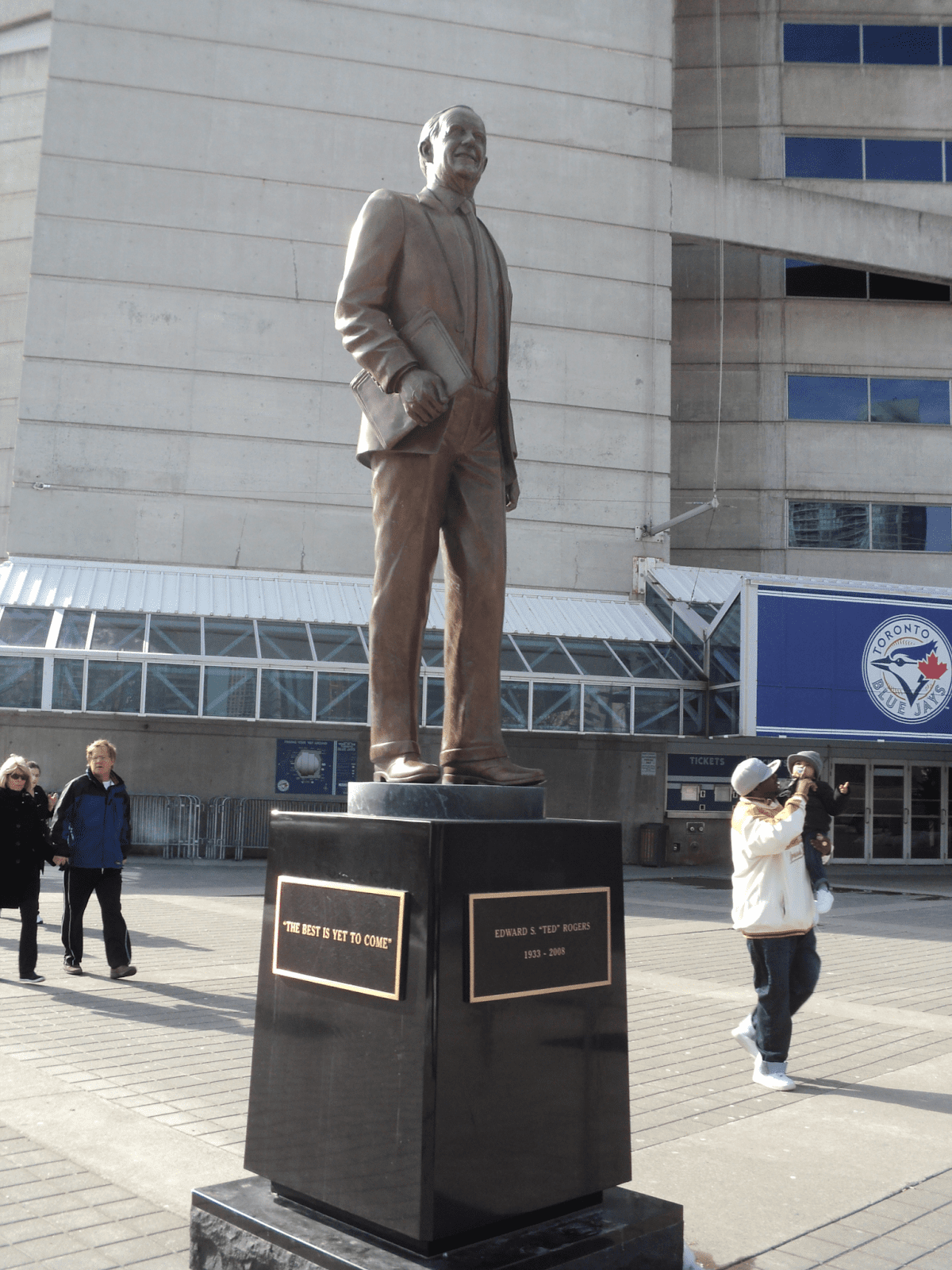
Ted Rogers was the founder and CEO of Rogers Communications, a businessman, and a philanthropist. Rogers was an innovator in the Canadian communications industry who built Rogers Communications. At the time of his death in 2008, Rogers was the fourth richest Canadian with a net worth of over $7 billion, while the company was valued at $18 billion and had approximately 29,000 employees. More at torontoski.
Childhood and Education
Ted Rogers was the only child of Edward Samuel and Velma Melissa Rogers. From birth, he had digestive problems (likely celiac disease), which caused him to be thin and have poor eyesight. Because of this, Rogers was often teased, but this only strengthened his determination and sense of purpose. Ted’s father invented the alternating current (AC) radio tube, which allowed home radios to be plugged into the electrical grid (before this, radios ran on large acid batteries). In 1927, Edward Sr. founded the radio station CFRB, the latter half of which stood for “Rogers Batteryless.” His father died at 38, shortly before Ted’s sixth birthday. After his death, many of his father’s companies and patents were hastily sold, but Ted promised himself he would one day buy them all back. In 1941, his mother married lawyer John Webb Graham.
Rogers grew up in the affluent Forest Hill neighbourhood of Toronto and attended the private Upper Canada College. From the age of seven, he lived in a boarding house. While studying, he organized an underground bookmaking business for horse racing and secretly installed a television antenna on the school’s roof. Against the institution’s rules, Rogers charged admission for his classmates to watch broadcasts from Buffalo, New York, in his room.

After this, Rogers studied at Trinity College at the University of Toronto. During this period, he organized youth conservative groups at universities across the country and worked with the Progressive Conservative Party in support of John Diefenbaker. In the summer months, Ted worked at the CKLW radio station in Windsor, and also ran a small musical equipment rental and performance booking agency called Rogers Music Services. He graduated from the University of Toronto in 1957, although he later admitted he was more of an inventive than a diligent student. Rogers later continued his studies at Osgoode Hall Law School, graduating in 1961. After that, he articled at the law firm Tory & Associates in Toronto. In 1962, he was called to the Bar. However, he never practiced law.
 Early Career in Broadcasting
While still articling, Rogers began his business career. In 1959, he founded Aldred Rogers Broadcasting Ltd. with Joel Aldred, a well-known broadcaster. That same year, Rogers dared to call John White Hughes Bassett, the executive director of Baton Broadcasting and publisher of the Toronto Telegram, with a proposal to partner in founding the first private television station in Toronto. Rogers was partly motivated by a desire to compete for the broadcast license against CFRB – the radio station his father had founded, but from which Ted had been, roughly speaking, ousted. His persistent approach worked, and on October 22, 1959, Baton Aldred Rogers Broadcasting Ltd. (BARB) was established. Other partners in the station included Paul Nathanson, founder of Odeon Theatres, and Foster Hewitt, the voice of Hockey Night in Canada. After the application process, BARB received the broadcast license for CFTO, which began operating on December 31, 1960. Rogers took the position of vice-president of CFTO.
In 1960, Rogers purchased the radio station CHFI, taking out an $85,000 loan. It was a risky move. Although CHFI was the only FM radio station broadcasting in Toronto, less than 5% of the city’s listeners had the new and expensive FM receivers. However, Ted was convinced that the future of radio was with the FM frequency, as it provided higher quality sound than the more popular AM frequency. Rogers even said he had an ear like Van Gogh, so he couldn’t be wrong. To increase listenership, Rogers bought FM receivers in bulk, put the CHFI logo on them, and sold them at cost – just as his father had done. Despite CHFI’s audience growing rapidly, the station was losing money due to high operating costs. In June 1961, competitor CFRB launched its own FM station, posing a direct challenge to CHFI. To offset the costs of the FM station and attract listeners to the new frequency, Rogers launched CHFI-AM in 1963 (later known as 680 News).
Cable Television
In 1967, Rogers founded Rogers Cable TV Limited, financing its infrastructure with a $250,000 loan from his wife Loretta’s trust fund. In partnership with Baton, Rogers Cable TV began operations in three Ontario markets: parts of Toronto, Brampton, and Leamington. However, due to high infrastructure construction costs, the company fell into debt, and new rules from the Canadian Radio-television and Telecommunications Commission (CRTC) forced Baton to sell its 50 percent stake in the company. This brought Rogers Cable TV to the brink of bankruptcy in 11971. During this period, Rogers mortgaged his home three times to save the business. His persistence and belief in the future of cable television eventually paid off. Rogers once recalled being laughed at when he said cable TV would be a big deal in Toronto. They said, “Why would anyone need it in Toronto?”.

Rogers Cable Television
In the 1970s, Rogers Cable grew rapidly, becoming the first cable company to offer subscribers more than 12 channels. In 1979, Rogers became a public company, listed on the Toronto Stock Exchange, after acquiring Canadian Cablesystems – a company almost twice its size. The following year, Rogers acquired Premier Cablevision. These deals made it the largest cable company in Canada.
In 1989, Rogers Communications sold its US cable assets, making a profit of $1 billion. The company invested these funds into CNCP Telecommunications (a telecommunications company formed by integrating the communications units of Canadian National and Canadian Pacific).

Personal Life
In 1963, Ted Rogers married Loretta Robinson, the daughter of John Roland Robinson, a British Member of Parliament and Governor of Bermuda. Ted and Loretta adopted their first child, Lisa Anne, in 1967, and later had Edward Samuel III (1969), Melinda Mary (1971), and Martha Loretta (1972). Rogers had four grandchildren. He worked alongside his son Edward, who held the position of president of Rogers Cable, and his daughter Melinda, who was senior vice-president of strategy and development at Rogers Communications.
Overall, Rogers’s personal life was closely intertwined with his career and business. He worked constantly: at home, at the cottage, and even during vacations. This sometimes harmed his family life. At the Rogers headquarters in Toronto, he set up a bedroom next to his office. Rogers was driven by the desire to restore his father’s legacy, so he worked tirelessly to achieve this goal. He also repeatedly tried to regain control of CFRB and, until the end of his life, was in negotiations to acquire its owner, Astral Media.